
What happens when a literature teacher channels her inner
Nancy Drew to break an inmate out of America’s most famous prison?

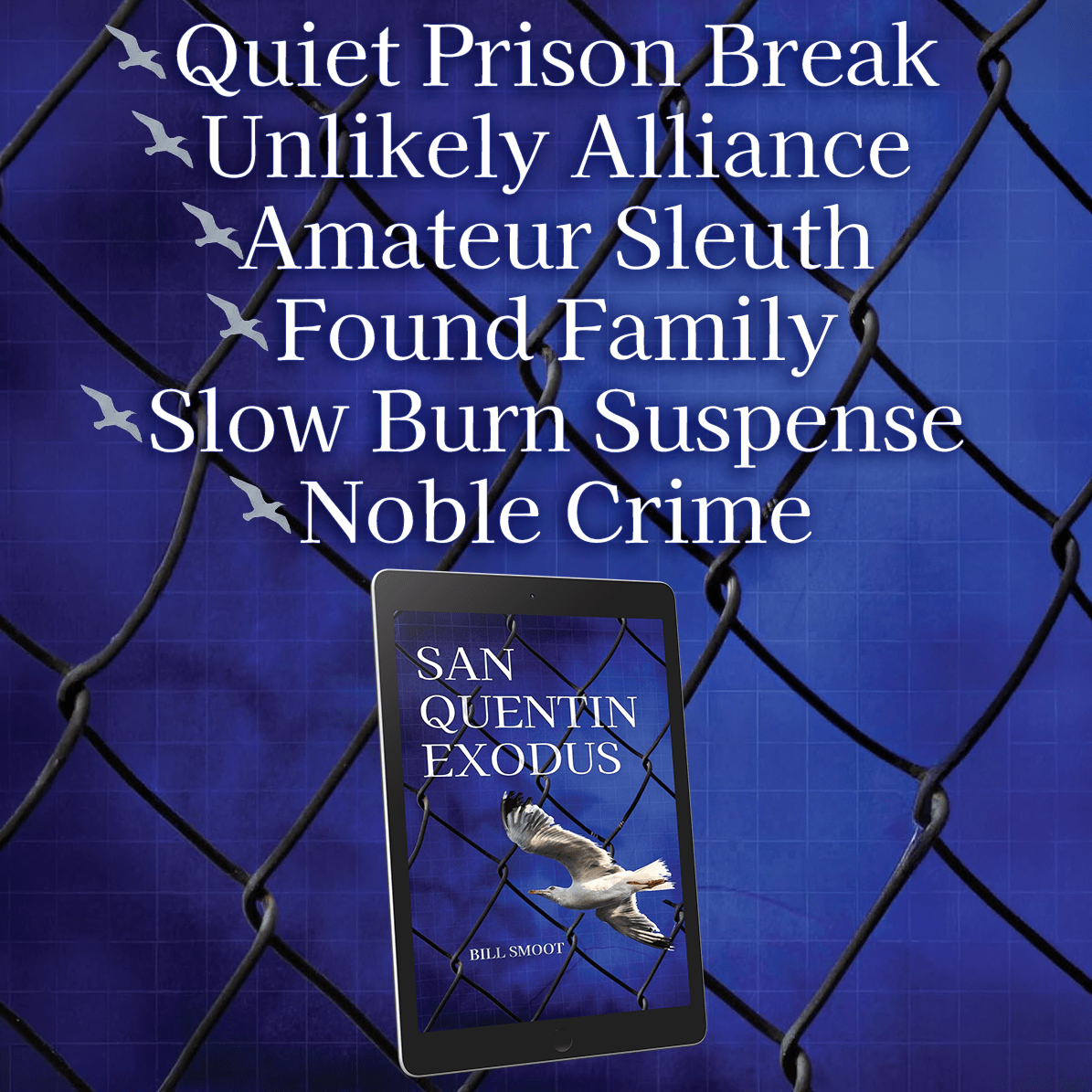
San Quentin Exodus
by Bill Smoot
Genre: Historical Literary Fiction, Crime Drama

James, a still-water-runs-deep boy, struggles to navigate
the rough streets of Oakland, California, in the 80s. His only friend is a pit
bull he rescues from dog fighting. On the cusp of college, James commits a
crime that results in a prison term of thirty to life.
Allison, a young Indiana girl obsessed with Nancy Drew
novels, vows that her life’s mission will be to solve mysteries and help
people. Introverted yet daring, Allison moves to Berkeley to teach prep school
and volunteers as a tutor at San Quentin. She meets James when he is
approaching fifty, learns his story, and after his parole denial, channels
Nancy Drew to plan his improbable escape.
San Quentin Exodux is a braided novel about two people whose
lives cross in a quest to reset an ill-fated life. It is a story infused with
misfortune and pain, but also with hope and a fierce humanity.
“San Quentin Exodus, Bill Smoot’s deeply compelling
novel, introduces readers to the world of prison but really to the much bigger
world of his characters’ lives, inviting us to follow the trajectory of each as
it unfolds with surprise and mystery, love and loss. Like all good
literature, San Quentin Exodus ultimately asks us to reconsider
everything we believe—or think we believe. Smoot is the consummate storyteller:
restrained, wise, compassionate.”
—Lori Ostlund, author of Are You
Happy?
Amazon * Apple
* B&N
* Bookbub
* Goodreads


Prologue
Wings
In
one week Allison Anderson will commit her first felony: section 4550 of the
California Penal Code, helping someone escape from a state prison. Almost
everyone who knows her would be stunned with disbelief. For her, it’s the
ultimate realization of who she is.
One autumn evening six years ago, Allison entered San
Quentin Prison as a volunteer tutor. Walking across the prison grounds, she
gazed at the forty-foot walls, the spirals of razor-
wire,
and the imposing guard towers. She wondered how an inmate might escape. It was
her first time in a prison, and the question engaged her problem-solving mind.
She did not know
that
one day she would devise an escape plan. She did not know that she would put
that plan into action. At the time, it was just a thought experiment, a
challenge for a woman whose childhood heroine was Nancy Drew, girl sleuth.
Allison’s most vivid memory of entering the prison that
evening was the birds. When she and her group rounded the hospital building and
walked across the yard, she saw geese and gulls scratching the ground on the
baseball field. It was mere minutes before the October sun would set, and their
white feathers glowed like gold. A single goose stretched his neck, dipped his
thick body, and with a push from his feet and a flapping of his great wings, he
rose from the ground and glided across the field, then soared over the wall.
Other geese did the same, their necks piercing the air like arrows. Sea gulls
followed. The walls and guard towers were mere landmarks below them, like trees
or outcroppings of rock, obstacles they cleared with ease. They didn’t need an escape
plan. They had wings.
The
First Day and the Last
They
say that the two days of prison an inmate remembers most vividly are his first
and his last. Everything in between is a blur. James’ first day was 30 years
ago. His last—maybe—will be in one week. If Hemingway’s character could walk
away from war, James can declare his separate peace from prison. It’s time to
move on, regardless of what the parole board has ruled. It’s necessary. An
absolute must.
For society, James is a statistic, another Black man
languishing in prison, costing the state $75,000 a year. His escape—if it
succeeds—will save taxpayers money. For himself, it will be his personal
exodus, his promised land of another chance at life. If things go according to
plan, no one will know how he did it. He will just disappear, a man become a
ghost. Allison is a smart young lady, and he can’t find any flaws in her plan,
but he is haunted by that old saying: If it seems too good to be true, then it
probably is.
James is filled with yearning and fear. The greater danger
is not that he’ll get caught and have time added to his sentence—though that’s
a real possibility—but that the hope he’s allowed himself to feel will die.
That’s the greater risk. The loss of hope he could not bear.
He lies in his bunk, trying to conjure up positive images.
The thought of freedom makes his skin prickle. The shadows of the bars cross
his body, spill onto the concrete floor. He listens to the cell block tick with
sound, as if the walls are straining to breathe. He imagines a sea gull soaring
on the wind.


Bill Smoot grew up in Maysville, Kentucky, and attended
Purdue University where he was editor of the campus newspaper, The Purdue
Exponent. Fired as editor by the university president, he was reinstated after
protest from students and faculty. He went on to graduate school at
Northwestern University, where he received a PhD in philosophy. He has taught
for four decades at levels ranging from sixth grade to university students. He
currently teaches courses at Mount Tamalpais College at San Quentin and the Osher
Institute for Lifelong Learning at UC-Berkeley. His essays and short stories
have such publications as Ninth Letter, Crab Creek Review. The Nation, Literary
Review, Crab Orchard Review, Western Humanities Review, Narrative, and
Salon.com. His the author of Conversations with Great Teachers and a novel,
Love: A Story. Mr. Smoot currently lives in Berkeley, California, with his dog
Artemis. His website is https://billsmoot.net

Enter the San Quentin Exodus Giveaway Here


Sounds interesting
ReplyDeleteThe blurb and excerpt sounds intriguing. Thanks for sharing.
ReplyDelete